- FrontFundr Weekly Newsfeed
- Posts
- 👖 Responsible denim campaign closing soon, alumni updates, and Canada's AI data centre bet
👖 Responsible denim campaign closing soon, alumni updates, and Canada's AI data centre bet
Triarchy is closing. General Technologies' new patent. GoodLife Brands' new releases. Alumni updates. Canada is building its own AI backbone. Founder feature with Elevate Farms. FrontFundr speaks at the 2026 PCMA Conference.

Sharry From FrontFundr
May 14, 2026
Hi Investor,
What's new this week?
👖Triarchy is closing in 6 days!
🦷 General Technologies' patent application has been published
🍹GoodLife Brands drops their Spring/Summer releases
🌾 Prairie Clean Enterprises’ CEO gives a tour of their flax processing facility
🚁 AIRmarket has announced a partnership with Westcan ACS
🧱 Canada is building its own AI backbone
🎙️Founder feature with Elevate Farms CEO Amin Jadavji
🎤 FrontFundr's Peter-Paul Van Hoeken joins the 2026 PCMA Conference
Today’s reading time is 5 minutes.
🔔 Your campaign updates feed

👖 Triarchy is closing in 6 days!
Triarchy is a family-run denim brand turned leader in eco-innovation. They have grown into a sustainable apparel company shaping the future of circular fashion, with cutting-edge materials, a nationwide presence, and a growing team behind them.
Invest in Triarchy | $108K Raised | 43% of target

🦷 General Technologies' patent application has been published
General Technologies has reached an important IP milestone. The USPTO has published our patent application for "System and Method for Automated Health Record Generation", strengthening the IP foundation behind ChartAI and our broader AI platform for healthcare documentation. Read more here.
Invest in General Technologies | $301K Raised | 38% of target

🍹GoodLife Brands drops their Spring/Summer releases
GoodLife Brands Spring/Summer 2026 is shaping up to be one of their most exciting release seasons yet. With new drops across the portfolio including Field House Brewing, NiceLife Cocktails, fresh limited releases from DryGoods Non-Alch and more. Read more here.
Invest in Goodlife Brand Collective | $599K Raised | 40% of target
🔔 Alumni updates

🌾 Prairie Clean Enterprises: Sustainable ag-tech manufacturer
Prairie Clean Enterprises’ CEO Mark Cooper gives a tour of their flax processing facility and gives a closer look at the equipment and daily operations.
🚁 AIRmarket: Air traffic control for drones
AIRmarket has announced a partnership with Westcan ACS to advance the drone-enabled economy in Alberta, starting in Edmonton. Read more.
🤔 What’s on our minds

🧱 Canada is building its own AI backbone
As countries race to build AI compute capacity, Canada is making its own move. The federal government and TELUS have jointly announced a large-scale AI data centre cluster in British Columbia. They frame it as a direct investment in Canada's digital sovereignty by keeping Canadian data, intellectual property, and AI workloops on Canadian soil.
🏗️ What's being built
TELUS plans to expand its existing Kamloops data centre and develop two new Vancouver facilities in partnership with local developer Westbank, one in the Mount Pleasant neighbourhood at the Hootsuite HQ and one downtown next to BC place stadium. The Kamloops expansion and Mount Pleasant facility will open later this year, while the downtown facility comes online in 2029.
The scale is significant. The three-site network will eventually support more than 60,000 GPUs and 150 megawatts of computing capacity by 2032, powered by NVIDIA's latest AI hardware. TELUS and its investors are spending $1 billion on the build, while the federal government has committed $2 billion over five years under its broader sovereign AI data centres initiative
🤔 Why it matters
The stakes behind this announcement go beyond a single infrastructure project. Canada's AI researchers and businesses currently depend heavily on American cloud providers, meaning Canadian data, intellectual property, and the economic value sits on foreign soil, subject to foreign laws. Building domestic computing capacity is one of the more concrete ways a government can reduce that exposure. The project is designed to support the full AI development process, from training large-scale models to deploying AI applications, entirely within Canadian-owned and operated infrastructure
🔭 What's ahead
Not everyone is sold. There are open questions about total government costs, as no specific project costs have been released. TELUS CEO Darren Entwistle, who is retiring after 26 years, described the cluster as a landmark moment for Canada's economic future, pointing to its capacity to run the world's most advanced AI models entirely on Canadian soil.
The data centres are only as valuable as the demand behind them. If Canadian researchers and businesses don't fill the capacity, the investment in sovereignty remains more symbolic than strategic.
🤖What would most strengthen Canada's AI strategy? |
🌐 Community Responses
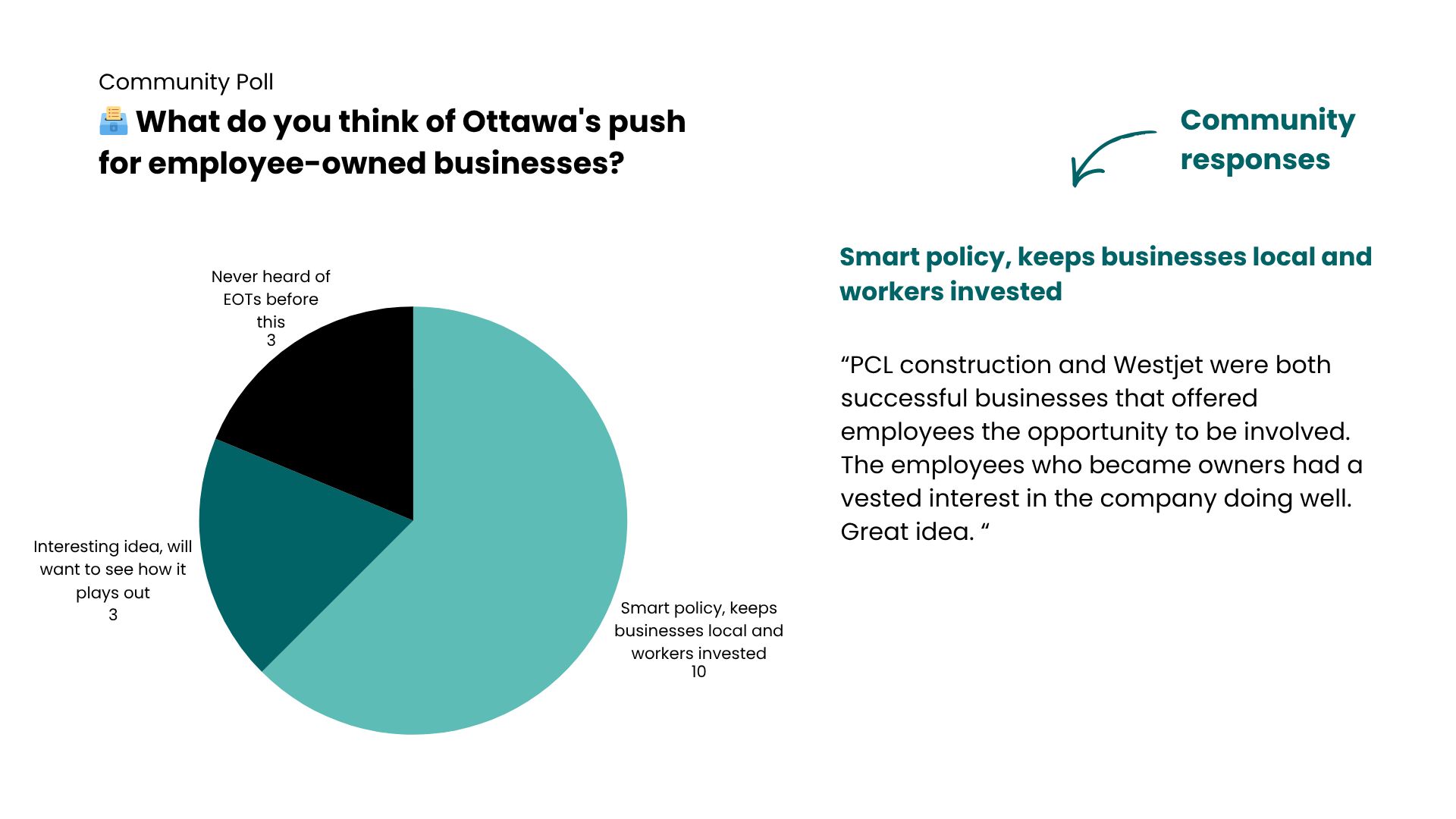
Sharing some community responses from last week’s newsletter article on Ottawa's push for employee-owned businesses.
🎙️ Hear from our founder feature

🥬 Elevate Farms: Cultivating Canada through indoor farming and innovation with Amin Jadavji
Q: You spent two decades in paper manufacturing before starting Elevate Farms. What made you pivot to food?
A: In the paper business, our biggest customers were the largest food distributors in North America. And I always noticed that nobody cared where their paper came from, but people do care where their food comes from. When I exited the paper company, I kept coming back to that idea, there has to be a way to use technology to grow food locally. That was really the beginning of Elevate Farms.
Q: The technology behind Elevate Farms is rooted in space research. Can you explain that connection?
A: My co-founder is based in Oslo and has spent his career in photobiology, the study of how light affects living organisms. In 2006, he started working on how to grow food at a fraction of Earth's atmosphere, which was really the precursor to Mars mission research. He ended up working with the Space Research Group at the University of Guelph and has been cited by NASA and the European Space Agency for that work. I was introduced to him through Guelph, and we co-founded Elevate Farms together in 2017.
Q: Indoor farming has seen a lot of hype and a lot of failures. What has Elevate done differently?
A: The challenge has always been doing this cost-effectively and at scale. If you're the most expensive product in the category, you haven't really solved the problem. We took a deep tech approach, which means it takes more time and more capital, but we weren't trying to rush to sell something quickly. We were trying to solve the problem properly. Scale is still the biggest hurdle in this industry, nobody has hit the volumes that make this truly viable at a mass market level yet. That's what we're building toward.
🎧 Want to listen to the full episode?
📌 FrontFundr Bulletin

🎤 FrontFundr's Peter-Paul Van Hoeken joins the 2026 PCMA Conference
We're also pleased to share that our Founder and CEO, Peter-Paul Van Hoeken, will be joining the 2026 PCMA (Private Capital Market Association) Conference as a panel speaker on the future of private markets, community investing, and capital innovation. PCMA also shared our 2025 Community Capital Report, highlighting how private markets are evolving through distributed capital formation, and stronger investor engagement. Read more.
Thoughts on today's newsletter? 🤔 |
Made an investment on FrontFundr recently? Consider sharing your experience on Trustpilot.
Reply